
How Monthly Bank Reconciliation Works and When to Hand It Off
- Bookkeeping
Nuage Digital
November 6, 2026
If you run a small business, the number in your banking app is probably the one you trust most. It’s also the one most likely to be off. Pending deposits, unrecorded bank fees and processor payouts net of fees mean your bank balance and your books rarely agree on their own. A bank reconciliation compares the two line by line and explains every difference until they match. For US business owners, that matching is what your tax return, your CPA and any lender rely on.
Skipping it carries real risk. According to the FBI’s latest Internet Crime Report, business email compromise cost US victims over $3 billion in 2025, usually through fake invoices and payments rerouted to fraudsters’ accounts. A monthly reconciliation is how you spot a payment that went to the wrong place within weeks, not at tax time. Here’s how it works, what bank reconciliation services include, and when it makes sense to hand the job to someone else.
What Is a Bank Reconciliation?
A bank reconciliation compares the cash balance in your accounting records with your bank statement for the same period. Every difference gets explained until the two adjusted balances match exactly. When it’s done every month, you know that every dollar in your books actually moved through the bank, and that every dollar the bank moved shows up in your books.
Which Accounts Need Reconciling?
It isn’t only your main checking account. Any account that holds or moves business money needs a monthly reconciliation:
- Checking and savings accounts
- Business credit cards
- Payment processors such as Stripe, Square and PayPal
- Loans and lines of credit
Why Your Bank Balance and Your Books Don't Match
The two balances rarely agree on their own. These are the usual reasons:
- Deposits in transit: money you’ve recorded that the bank hasn’t posted yet.
- Outstanding checks: checks you’ve written that haven’t cleared.
- Bank fees and interest: the bank records these before you do.
- Returned payments: a customer payment that bounced.
- Processor payouts net of fees: you record $10,000 in sales, but the processor deposits $9,690 after fees and refunds.
- Errors: duplicate entries, transposed numbers, or transactions posted to the wrong account.
A Simple Bank Reconciliation Example
Here’s what a finished reconciliation looks like. The bank side and the book side start at different numbers and end at the same adjusted balance.
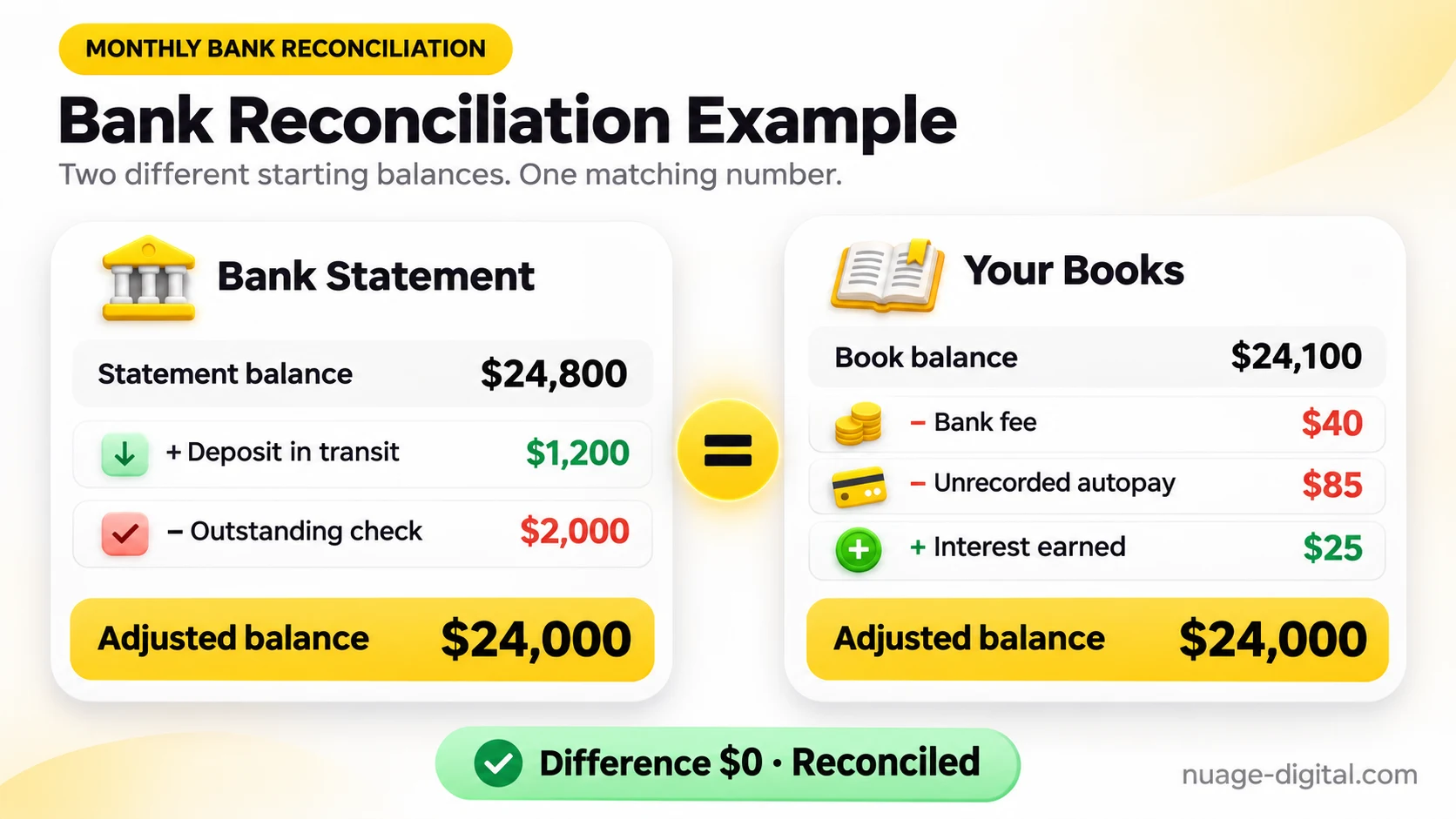
When both sides land on the same number, the account is reconciled. If they don’t match, there’s still a difference to explain. “Close enough” doesn’t count.
What's Included in Bank Reconciliation Services
A bank feed only imports your transactions. A reconciliation proves those transactions match the bank statement. A proper bank reconciliation service covers:
- Every account, every month: checking, savings, credit cards, payment processors and loans.
- Statement-based matching: each transaction checked against the actual statement, not only the bank feed.
- Exception handling: unknown deposits, duplicates and missing receipts, with your questions sent in one batch.
- Adjusting entries: fees, interest, returned payments and processor fees recorded correctly.
- Stale item cleanup: old outstanding checks and deposits that never cleared, cleared out.
- Credit card reconciliation: card statements reconciled so personal charges and duplicate subscriptions get caught.
- Monthly reports: a reconciliation report for every account, ready for your CPA or lender.
At Nuage Digital, monthly bank and credit card reconciliations are part of our bookkeeping services.
How Often Should You Reconcile Your Bank Accounts?
Every business should reconcile its bank accounts at least once a month. Do it after each statement closes, and try to finish within the first two weeks of the next month, because errors get harder to trace the longer they sit. If you run a restaurant, retail shop or e-commerce store with heavy card sales, reconcile weekly so payout gaps and chargebacks don’t pile up. It’s also worth reconciling after every payroll run and before key deadlines such as quarterly estimated tax payments, year-end close or a loan application. Quarterly is the absolute latest, since by then a single error can mean reworking three months of entries. The more transactions you have, the more often you should reconcile, and monthly is the minimum, not the goal.
The Monthly Bank Reconciliation Process, Step by Step
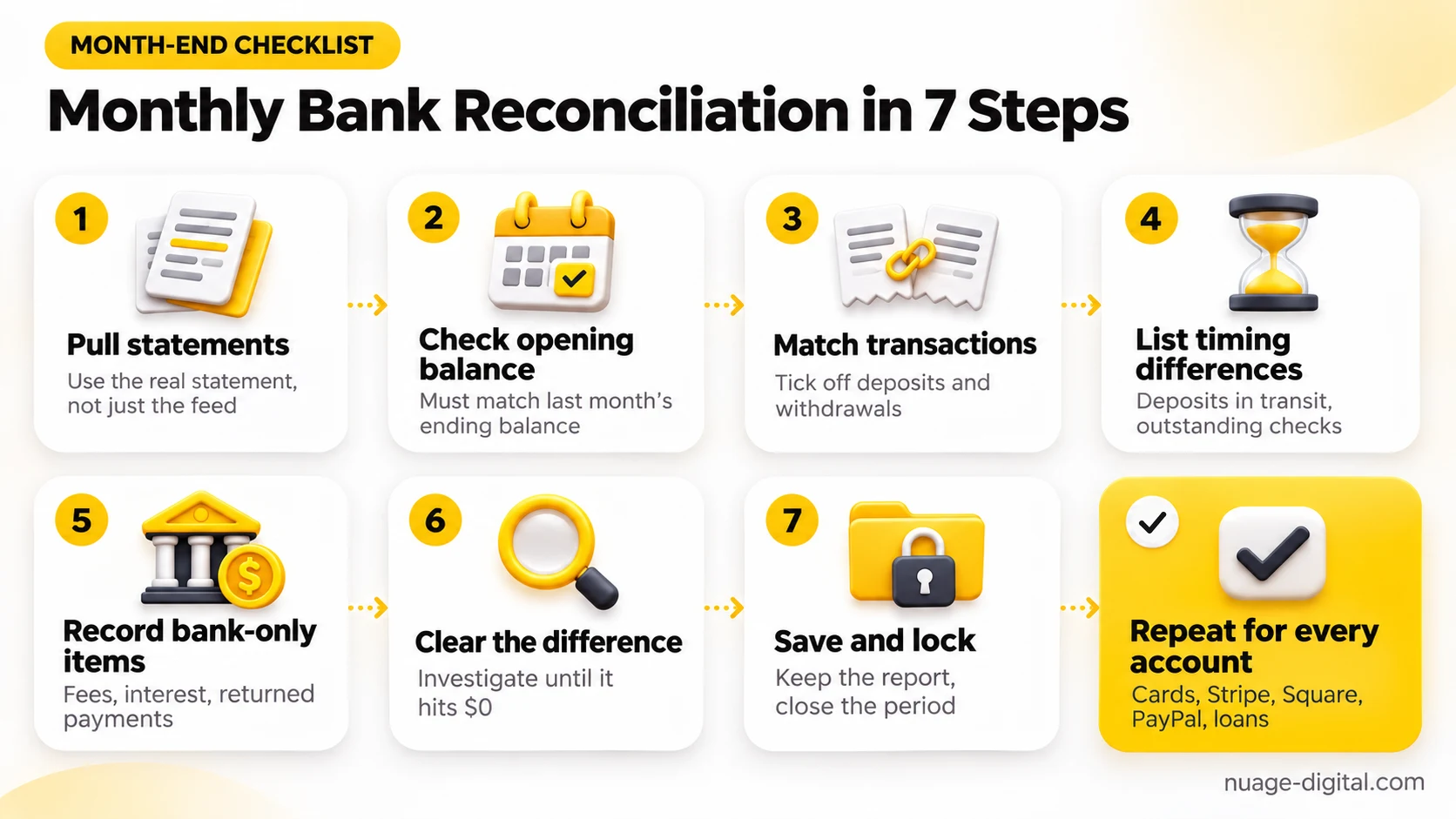
- Pull every statement: use the actual bank statement, not just the bank feed.
- Check the opening balance: it should equal last month’s reconciled ending balance.
- Match transactions: tick off deposits and withdrawals on both sides.
- List timing differences: deposits in transit and outstanding checks.
- Record bank-only items: fees, interest, returned payments and autopays.
- Clear the difference: investigate whatever is left until it reaches $0.
- Save and lock: keep the report and close the period.
Repeat these steps for every credit card, payment processor and loan account.
Signs It's Time to Outsource Bank Reconciliation
Many owners handle their own reconciliations at first. If any of the signs below sounds familiar, it’s probably time to outsource bank reconciliation:
- You’re two or more months behind. Each month you skip makes the next one harder, and catching up takes longer than staying current.
- There’s a “plug” in your books. Someone forced an unexplained difference to match instead of finding what caused it.
- You manage too many accounts. Several bank accounts, credit cards, payment processors or entities turn reconciliation into a part-time job.
- You’re reconciling at night. That time would be better spent on sales, clients or your team.
- Your CPA keeps asking for reports. If you can’t hand over monthly reconciliation reports, your tax prep will cost more and take longer.
- A big financial event is coming. Lenders, investors and buyers will check your reconciled books first if you’re applying for a loan, raising money or selling the business.
- The bank feed is doing your thinking. Auto-matching rules miscategorize transactions, and nobody is reviewing the exceptions.
If two or more of these apply, a monthly bookkeeping service that includes reconciliation will save you time and catch problems before tax season.
Choosing a Bank Reconciliation Service in the Bay Area
A good bank reconciliation service does more than tick boxes. Before you sign with a provider, ask these questions:
- Which accounts are included? Make sure credit cards, payment processors such as Stripe and Square, and loans are covered, not only your checking account.
- When will my books be reconciled each month? A provider should commit to a clear date, ideally within the first two weeks of the following month.
- How will you handle questions? You want your questions grouped into one batch, not a steady stream of emails about every unknown transaction.
- What reports will I receive? Ask for a monthly reconciliation report for each account, ready to hand to your CPA or lender.
- Do you work in my accounting software? Switching systems just to suit a provider adds cost and risk.
- Does this connect to my tax prep? Reconciled books should flow straight into your tax return, without a separate cleanup at year end.
- How is pricing calculated? Most providers price by the number of accounts and transaction volume, so get the basis in writing.
Nuage Digital is based in Campbell. We work with small businesses across San Jose, Santa Clara, Sunnyvale, Cupertino and the wider Bay Area. Bookkeeping, payroll and tax preparation are handled under one roof, so your reconciled numbers carry directly into your tax return.
Want your accounts reconciled every month, on schedule? Nuage Digital’s bookkeeping team handles monthly bank and credit card reconciliations for Bay Area small businesses and sends you a report every month. Book a meeting or call (408) 495-3989. You can also see our pricing.
Trusted By Greater Companies






2 Responses